A Giant Takes On Physics’ Biggest Questions
——天才挑战物理之极
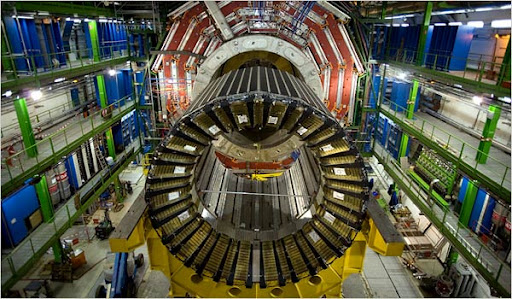
At Cern, the Large Hadron Collider could recreate conditions that last prevailed when the universe was less than a trillionth of a second old. Above is one of the collider's massive particle detectors, called the Compact Muon Solenoid.
Valerio Mezzanotti for The New York Times300 FEET BELOW MEYRIN, Switzerland — The first thing that gets you is the noise.
http://www.nytimes.com/ref/science/20070514_CERN_GRAPHIC.html
Physics, after all, is supposed to be a cerebral pursuit. But this cavern almost measureless to the eye, stuffed as it is with an Eiffel Tower’s worth of metal, eight-story wheels of gold fan-shape boxes, thousands of miles of wire and fat ductlike coils, echoes with the shriek of power tools, the whine of pumps and cranes, beeps and clanks from wrenches, hammers, screwdrivers and the occasional falling bolt. It seems no place for the studious.
The physicists, wearing hardhats, kneepads and safety harnesses, are scrambling like Spiderman over this assembly, appropriately named Atlas, ducking under waterfalls of cables and tubes and crawling into hidden room-size cavities stuffed with electronics.
They are getting ready to see the universe born again.
Again and again and again — 30 million times a second, in fact.
Starting sometime next summer if all goes to plan, subatomic particles will begin shooting around a 17-mile underground ring stretching from the European Center for Nuclear Research, or Cern, near Geneva, into France and back again — luckily without having to submit to customs inspections.
Crashing together in the bowels of Atlas and similar contraptions spaced around the ring, the particles will produce tiny fireballs of primordial energy, recreating conditions that last prevailed when the universe was less than a trillionth of a second old.
Whatever forms of matter and whatever laws and forces held sway Back Then — relics not seen in this part of space since the universe cooled 14 billion years ago — will spring fleetingly to life, over and over again in all their possible variations, as if the universe were enacting its own version of the “Groundhog Day” movie. If all goes well, they will leave their footprints in mountains of hardware and computer memory.
“We are now on the endgame,” said Lyn Evans, of Cern, who has been in charge of the Large Hadron Collider, as it is called, since its inception. Call it the Hubble Telescope of Inner Space. Everything about the collider sounds, well, large — from the 14 trillion electron volts of energy with which it will smash together protons, its cast of thousands and the $8 billion it cost to build, to the 128 tons of liquid helium needed to cool the superconducting magnets that keep the particles whizzing around their track and the three million DVDs worth of data it will spew forth every year.
The day it turns on will be a moment of truth for Cern, which has spent 13 years building the collider, and for the world’s physicists, who have staked their credibility and their careers, not to mention all those billions of dollars, on the conviction that they are within touching distance of fundamental discoveries about the universe. If they fail to see something new, experts agree, it could be a long time, if ever, before giant particle accelerators are built on Earth again, ringing down the curtain on at least one aspect of the age-old quest to understand what the world is made of and how it works.
“If you see nothing,” said a Cern physicist, John Ellis, “in some sense then, we theorists have been talking rubbish for the last 35 years.”
Fabiola Gianotti, a Cern physicist and the deputy spokeswoman for the team that built the Atlas, said, “Something must happen.”
The accelerator, Dr. Gianotti explained, would take physics into a realm of energy and time where the current reigning theories simply do not apply, corresponding to an era when cosmologists think that the universe was still differentiating itself, evolving from a primordial blandness and endless potential into the forces and particles that constitute modern reality.
She listed possible discoveries like a mysterious particle called the Higgs that is thought to endow other particles with mass, new forms of matter that explain the mysterious dark matter waddling the cosmos and even new dimensions of spacetime.
“For me,” Dr. Gianotti said, “it would be a dream if, finally, in a couple of years in a laboratory we are going to produce the particle responsible for 25 percent of the universe.”
Halfway around the ring stood her rival of sorts, Jim Virdee from Imperial College London, wearing a hardhat at the bottom of another huge cavern. Dr. Virdee is the spokesman, which is physics-speak for leader, of another team, some 2,500 strong, with another giant detector, the poetically named Compact Muon Detector, which was looming over his shoulder like a giant cannon.
The prospect of discovery, Dr. Virdee said, is what sustained him and his colleagues over the 16 years it took to develop their machine. Without such detectors, he said, “this field which began with Newton just stops.”
“When we started, we did not know how to do this experiment and did not know if it would work,” he said. “Twenty-five hundred scientists can work together. Our judge is not God or governments, but nature. If we make a mistake, nature will not hesitate to punish us.”
Game of Cosmic Leapfrog
The advent of the Cern collider also cements a shift in the balance of physics power away from American dominance that began in 1993, when Congress canceled the Superconducting Supercollider, a monster machine under construction in Waxahachie, Tex. The supercollider, the most powerful ever envisioned, would have sped protons around a 54-mile racetrack before slamming them together with 40 trillion electron volts.
For decades before that, physicists in the United States and Europe had leapfrogged one another with bigger, more expensive and, inevitably, fewer of these machines, which get their magic from Einstein’s equation of mass and energy. The more energy that these machines can pack into their little fireballs, the farther back in time they can go, closer and closer to the Big Bang, the smaller and smaller things they can see.Recalling those times, Dr. Evans said: “There was a nice equilibrium across the Atlantic. People used to come and go.”
Now, Dr. Evans said, “The center of gravity has moved to Cern.”
The most powerful accelerator now operating is the trillion-electron volt Tevatron, colliding protons and their antimatter opposites, antiprotons, at the Fermi National Accelerator Laboratory in Batavia, Ill. But it is scheduled to shut down by 2010,
Cern was born amid vineyards and farmland in the countryside outside Geneva in 1954 out of the rubble of postwar Europe. It had a twofold mission of rebuilding European science and of having European countries work together.
Today, it has 20 countries as members. Yearly contributions are determined according to members’ domestic economies, and a result is a stable annual budget of about a billion Swiss francs. The vineyards and cows are still there, but so are strip malls and shopping centers.
It was here that the World Wide Web was born in the early 1990s, but the director-general of Cern, Robert Aymar, joked that the lab’s greatest fame was as a locus of conspiracy in the novel “Angels and Demons,” by the author of “The DaVinci Code,” Dan Brown. The lab came into its own scientifically in the early ’80s, when Carlo Rubbia and Simon van der Meer won the Nobel Prize by colliding protons and antiprotons there to produce the particles known as the W and Z bosons, which are responsible for the so-called weak nuclear force that causes some radioactive decays.
Bosons are bits of energy, or quanta, that, according to the weird house rules of the subatomic world, transmit forces as they are tossed back and forth in a sort of game of catch between matter particles. The W’s and Z’s are closely related to photons, which transmit electromagnetic forces, or light.
The lab followed up that triumph by building a 17-mile-long ring, the Large Electron-Positron collider, or Lep, to manufacture W and Z particles for further study. Meanwhile, the United States abandoned plans for an accelerator named Isabelle to leapfrog to the giant supercollider in Texas.
Even before that supercollider was canceled, in 1993, however, Cern physicists had been mulling building their own giant proton collider in the Lep tunnel.
In 1994, after the supercollider collapse gave its own collider a clear field, the Cern governing council gave its approval. The United States eventually agreed to chip in $531 million for the project. Cernalso arranged to borrow about $400 million from the European Investment Bank. Even so, there was a crisis in 2001 when the project was found to be 18 percent over budget, necessitating cutting other programs at the lab. The collider’s name comes from the word hadron, which denotes subatomic particles like protons and neutrons that feel the “strong” nuclear force that binds atomic nuclei.
Whether the Europeans would have gone ahead if the United States had still been in the game depends on whom you ask. Dr. Aymar, who was not there in the ’90s, said there was no guarantee then that the United States would succeed even if it did proceed.
“Certainly in Europe the situation of Cern is such that we appreciate competition,” he said. “But we assume we are the leader and we have all intention to remain the leader. And we’ll do everything which is needed to remain the leader.”
To match the American machine, however, the Europeans, with a much smaller tunnel — 17 miles instead of 54 —had to adopt a riskier design, in particular by doubling the strength of their magnets.
“In this business, society is prepared to support particle physics at a certain level,” Dr. Evans saids. “If you want society to accept this work which is not cheap, you have to be really innovative.”
Cocktail Party Physics
The payoff for this investment, physicists say, could be a new understanding of one of the most fundamental of aspects of reality, namely the nature of mass.
This is where the shadowy particle known as the Higgs boson, a k a the God particle, comes in.
In the Standard Model, a suite of equations describing all the forces but gravity, which has held sway as the law of the cosmos for the last 35 years, elementary particles are born in the Big Bang without mass, sort of like Adam and Eve being born without sin.
Some of them (the particles, that is) acquire their heft, so the story goes, by wading through a sort of molasses that pervades all of space. The Higgs process, named after Peter Higgs, a Scottish physicist who first showed how this could work in 1964, has been compared to a cocktail party where particles gather their masses by interaction. The more they interact, the more mass they gain.
The Higgs idea is crucial to a theory that electromagnetism and the weak force are separate manifestations of a single so-called electroweak force. It shows how the massless bits of light called photons could be long-lost brothers to the heavy W and Z bosons, which would gain large masses from such cocktail party interactions as the universe cooled.
The confirmation of the theory by the Nobel-winning work at Cern 20 years ago ignited hopes among physicists that they could eventually unite the rest of the forces of nature.
Moreover, Higgs-like fields have been proposed as the source of an enormous burst of expansion, known as inflation, early in the universe, and, possibly, as the secret of the dark energy that now seems to be speeding up the expansion of the universe. So it is important to know whether the theory works and, if not, to find out what does endow the universe with mass.
But nobody has ever seen a Higgs boson, the particle that personifies this molasses. It should be producible in particle accelerators, but nature has given confusing clues about where to look for it. Measurements of other exotic particles suggest that the Higgs’s mass should be around 90 billion electron volts, the unit of choice in particle physics. But other results, from the Lep collider here before it shut down in 2000, indicate that the Higgs must weigh more than 114 billion electron volts. By comparison, an electron is half a million electron volts, and a proton is about 2,000 times heavier.
“We’ve nearly ruled out the Standard Model, if you want to say it that way,” said John Conway, a Fermilab physicist. The new collider was specifically designed to hunt for the Higgs particle, which is key both to the Standard Model and to any greater theory that would supersede it.
Theorists say the Higgs or something like it has to show up simply because the Standard Model breaks down and goes kerflooey at energies exceeding one trillion electron volts. If you try to predict what happens when two particles collide, it gives nonsense, explained Dr. Ellis of Cern, a senior theorist with the long white hair and a bushy beard to prove it.
“There is either a violation of probability or some new physics,” Dr. Ellis said.
Nima Arkani-Hamed of Harvard said he would bet a year’s salary on the Higgs.
“If the Higgs or something like it doesn’t exist,” Dr. Arkani-Hamed said, “then some very basic things like quantum mechanics are wrong.”
A result, Dr. Gianotti said, is “either we find the Higgs boson, or some stranger phenomenon must happen.”
Nightmares
If the Cern experimenters find the Higgs, Nobel Prizes will flow like water. But just finding the elusive particle will not be enough to satisfy the theorists, who profess to be haunted by a much deeper problem, namely why the putative particle is not millions of times heavier than it appears to be.
When they try to calculate the mass of the Higgs particle using the Standard Model and quantum mechanics, they get what Dr. Ellis called “a very infinite answer.”
Rather than a trillion electron volts or so, quantum effects push the mass all the way up to 10 quadrillion trillion electron volts, known as the Planck energy, where gravity and the other particle forces are equal.
The culprit is quantum weirdness, one principle of which is that anything that is not forbidden will happen. That means the Higgs calculation must include the effects of its interactions with all other known particles, including so-called virtual particles that can wink in and out of existence, which shift its mass off the scale.
As a result, if the Standard Model is valid for all energies, said Joe Lykken, a Fermilab theorist, “then you are in deep doodoo trying to explain why the Higgs mass isn’t a quadrillion times bigger than it needs to be.”
Another way to put it is to ask why gravity is so much weaker than the other forces — the theory wants them all to be equal.
Theorists can rig their calculations to have the numbers come out right, but it feels like cheating. “What we have to do to equations is crazy,” Dr. Arkani-Hamed said.
One solution that has been proposed is a new principle of nature called supersymmetry that, if true, would be a bonanza for the Cern collider.
It posits a relation between the particles of matter like electrons and quarks and particles that transmit forces like photons and the W boson. For each particle in one category, there is an as-yet-undiscovered superpartner in the other category.
“Supersymmetry doubles the world,” Dr. Arkani-Hamed said.
These superpartners cancel out all the quantum effects that make the Higgs mass skyrocket. “Supersymmetry is the only known way to manage this,” Dr. Lykken said.
Because Higgs bosons are expected to be produced very rarely, it could take at least a year or more for physicists to confirm their discovery at the collider. But some supersymmetric particles, if they exist, should be produced abundantly and could thus pop out of the data much sooner. “Suppose a gluino exists at 300 billion electron volts,” Dr. Arkani-Hamed said, referring to a putative superpartner. “We could know the first day if they exist.”
For several years, supersymmetry has been a sort of best bet to be the next step beyond the Standard Model, which is undefeated in experiments but has enormous gaps. The Standard Model does not include gravity or explain why, for example, the universe is matter instead of antimatter or even why particles have the masses they do.
In the end, Michelangelo Mangano, a theorist at Cern, said, “The standard model prediction can’t be the end of the story.”
Supersymmetry also fixes a glitch in the age-old dream of explaining all the forces of nature as manifestations of one primordial force. It predicts that at a high enough energy, all the forces — electromagnetic, strong and weak — have identical strengths.
“If supersymmetry is right, unification works,” Dr. Ellis said.
But there is no direct evidence for any of the thousands of versions of supersymmetry that have been proposed. Indeed, many theorists are troubled that its effects have not already shown up in precision measurements at accelerators.
“It doesn’t smell good,” Dr. Arkani-Hamed said. Physicists say the best indirect evidence for supersymmetry comes from the skies, where the galaxies have been found to be swaddled by clouds of invisible dark matter, presumably unknown particles left over from the Big Bang. “Dark matter is a very physical argument.” Dr. Ellis said. “If you take astrophysics seriously, there has to be some unseen stuff out there.”
On the menu of discoveries, there is always None of the Above. As Dr. Gianotti put it: “Nature has chosen another solution. This will be great.”
There are indeed other potential solutions that go by the name of Technicolor or the Little Higgs. But what if the collider sees nothing?
That, Dr. Ellis said, would be interesting for the theorists, who would have to retool and try to think even deeper thoughts about quantum mechanics and relativity, but bad for the experimentalists. Without any results, they would be unlikely to obtain financing for the next big machine planned, the $7 billion International Linear Collider.
A worse nightmare, several theorists said, would be seeing just the Higgs, but nothing else. That would leave them where they are, stuck in the Standard Model, with no answer to their embarrassing fine-tuning problem, no dark matter and no clue to a better theory.
To add to the confusion, according to the Standard Model, the Higgs can have only a limited range of masses without severe damage to the universe. If it is too light, the universe will decay. If it is too heavy, the universe would have blown up already. According to Dr. Ellis, there is a magic value between 160 billion and 180 billion electron volts that would ensure a stable universe and require no new physics at all.
But that would leave theorists with nothing more to do and a world in which basic questions would remain forever unanswered.
Dr. Ellis said, “ I can’t believe God would push the button on a theory like that.”
But, he conceded, “For the I.L.C., a boring Higgs is better than nothing.”
Sunken Cathedrals
There was more than birds singing and trees blooming outside the main Cern cafeteria in March to suggest that springtime for physics was approaching.
Some 300 feet beneath the warming grass, the magnets that are the guts of the collider, thick as tree trunks, long as boxcars, weighing in at 35 tons apiece, were strung together like an endless train stretching away into the dim lamplight and around a gentle curve.
A technician on his way to a far sector of the collider ring bicycled past.
“When you fold in the technology combined with the scale,” said Peter Limon, a Fermilab physicist on duty here, “I don’t think anything on Earth or in space that we know about beats it.”
Running through the core of this train, surrounded by magnets and cold, were two vacuum pipes, one for protons going clockwise, the other counterclockwise. Traveling in tight bunches along the twin beams, the protons will cross each other at four points around the ring, 30 million times a second. During each of these violent crossings, physicists expect that about 20 protons, or the parts thereof — quarks or gluons — will actually collide and spit fire. It is in vast caverns at those intersection points that the knee-padded and hardhatted physicists are assembling their detector, or “sunken cathedrals” in the words of a Cern theorist, Alvaro de Rujula, to capture the holy fire.Two of the detectors are specialized. One, called Alice and led by Jurgen Schukraft of Cern, is designed to study a sort of primordial fluid, called a quark-gluon plasma, that is created when the collider smashes together lead nuclei.
The other, LHCb, is led by Tatsuya Nakada of Cern and the Swiss Federal Institute of Technology in Lausanne. It is designed to hunt for subtle differences in matter and antimatter that could help explain how the universe, which was presumably born with equal amounts of both, came to be dominated by matter.
The other two, the aforementioned Atlas and Compact Muon Solenoid, or C.M.S. for short, are the designated rival workhorses of the collider, designed expressly to capture and measure every last spray of particle and spark of energy from the proton collisions.
The rivals represent complementary strategies for hunting the Higgs particle, which is expected to disintegrate into a spray of lesser particles. Exactly which particles depends on how massive the Higgs really is.
One telltale signature of the Higgs and other subatomic cataclysms is a negatively charged particle known as a muon, a sort of heavy electron that comes flying out at nearly the speed of light. Physicists measure muon momentum by seeing how much their paths bend in a magnetic field.
It is the need to have magnets strong enough and large enough to produce measurable bending, physicists say, that determines the gigantic size of the detectors.
The Compact Muon Solenoid, built by Dr. Virdee’s group, weighs 12,000 tons, the heaviest instrument ever made. It takes its name from a massive superconducting electromagnet that produces a powerful field running along the path of the protons.
Conversely, the magnetic field on Atlas wraps like tape around the proton beam. The Atlas collaboration has been led from its start by Peter Jenni of Cern. At150 feet long and 80 feet high, Atlas is bigger than its rival, but it is much lighter, about 7,000 pounds, about as much as the Eiffel Tower. The physicists like to joke that if you threw it in the ocean in a plastic bag it would float.
The two detectors have much in common, including “onion layers” of instruments to measure different particles and the ability to cope with harsh radiation and vast amounts of data. Dr. Virdee compared the central C.M.S. detector, made of strips of silicon that record the passage of charged particles, to a 60-megapixel digital camera taking 40 million pictures a second. “We have to time everything to the nanosecond,” he said
To manage this onslaught the teams’ computers have to perform triage, and winnow those events to a couple hundred per second. That is dangerous, Dr. Gianotti said, “because we are looking for something rare.” The Higgs occurs once in every trillion events, she said.
Contending Armies
The competition between Atlas and the C.M.S. is in keeping with a long tradition of having rival teams and rival detectors at big experiments to keep each other honest and to cover all the bets. As Dr. Mangano put it, “If you screw it up, others are here to crucify you.”
At the Fermilab Tevatron, the teams, several hundred strong, are called CDF and D0. In the glory years 20 years ago at Cern, they were called UA1 and UA2. Over the years, as the machines have grown, so have the groups that built them, from teams to armies, 1,800 people from 34 countries for Atlas and 2,520 from 37 countries for the C.M.S. The other two experiments — Alice with 1000 scientists, and LHCb with 663 — are only slightly smaller.
Robert Cousins of U.C.L.A. and C.M.S. joked that he was old enough so that after 25 years in the business “half my friends are on Atlas, the others on C.M.S.” Dr. Jenni said all 1,800 Atlas scientists would have their names on the first papers out of the collider, adding: “The people who work in the pit make as important a physics contribution as those who end up in front of the computers. This is a big step in energy. It’s new territory, and that’s in the end why everyone is excited.”
At the end of the day, Dr. Mangano said, unless there is a major problem both machines will perform. “It will come down to sociology,” he said. “How quickly can they analyze the date? How do you manipulate and analyze the data? The process of understanding is long.”
There could be new phenomena, he added, new particles that theorists have not thought of.
Dr. Mangano pointed out that it had been a long time since high-energy physicists had made a fundamental discovery. And back then, when Dr. Rubbia was doing his Nobel work, there were well-defined theories of what would be found. Now, everything will be new.
“There are many students who have never seen data,” Dr. Mangano said. “I don’t know how much longer we can keep going like that.”
What comes out of the Large Hadron Collider, he said, “will determine the future of the field.”
Dr. Arkani-Hamed said the tension was keeping him awake at night. “Nobody knows how this is going to go,” he said. “That’s what makes it so cool. The experiment itself is so spectacular.”
Sipping an espresso in his office, Dr. Mangano refused to consider the possibility of failure. “It’s like saying suppose you drive into a tree on the way home,” he said. “Let’s hope we get home safely and we see something.”


 have found that older adults who spent more time in leisure activities that required more mental effort had reduced chance of developing Alzheimer's disease. There are plenty of ways to fight forgetfulness and keep your brainpower going strong.

